TL;DR
Cliff Stevens, founder of ForeFront Simulator Solutions, puts a commercial or country club simulator bay at roughly $50,000 to $150,000, with most clubs that want something really nice landing between $75,000 and $90,000 per bay. Corey Ferger of The Club Partners argues the investment pays off when it brings members to the club more often: 400 golf members making one extra visit a month at $50 each adds about $20,000 a month in revenue.
- Cliff Stevens estimates $50,000 to $150,000 per bay in a commercial setting. Fit and finish is the main driver of where a project lands in that range.
- A TrackMan bay with top-tier finishes such as dark stained wood, leather and bronze trim runs near $150,000. A basic bay where finishes matter less is closer to $50,000.
- Cliff Stevens guides most clubs that want to build something really nice toward $75,000 to $90,000 per bay.
- Corey Ferger’s example: 400 golf members each making one more visit a month at an average $50 spend adds $20,000 a month to club revenue.
- Cliff Stevens contrasts spending $90,000 per bay to gain one more visit per member per month with spending $60,000 and gaining a tenth of a visit. He calls the cheaper option penny wise and pound foolish.
- Corey Ferger compares a $25,000,000 course renovation, with roughly three years of disruption, to three or four simulator bays costing a couple hundred thousand dollars that can generate revenue.
What drives the cost of a club golf simulator bay?
Cliff Stevens: It depends. It’s a classic “it depends.”
Corey Ferger: What’s important is: are you a tour pro? Are you an aspiring tour pro? What is the purpose? It all points back to number one. What is the purpose of the simulator? If you’re trying to create a really fun environment that is entry level and a place to offload some of the traffic from the driving range, you can do that at a much different price point than if you’re trying to build out a space that is as elevated as the rest of the club.
I argue that a club as a whole is only as good as its bottom rung, its weakest link. If you have this wonderful club experience, but the staff is terrible and the service is terrible, the whole food experience and the whole golf experience get dragged down by that. Putting a corner-cutting simulator into a great club is only going to drag down the rest of the club.
We’ve done projects with universities, high-level Division I programs, where their expectations and their needs are far different than those of a seven or eight handicap. Making sure that they have access to the best technology, done in a way that’s going to help them perform better on the course and in competition, is far different than having a great spot to go beat balls on a lunch break.
How much does a country club simulator bay cost?
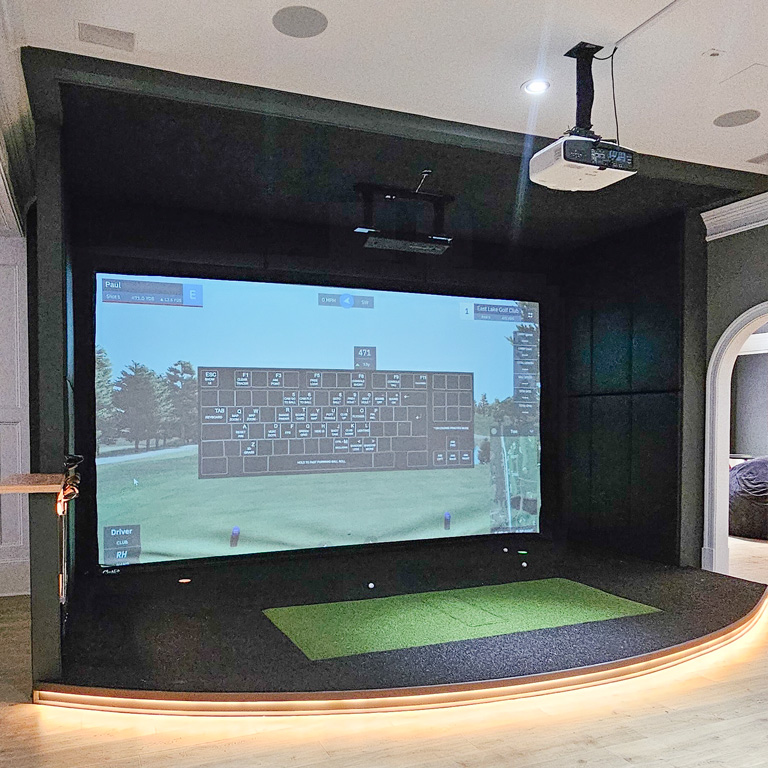
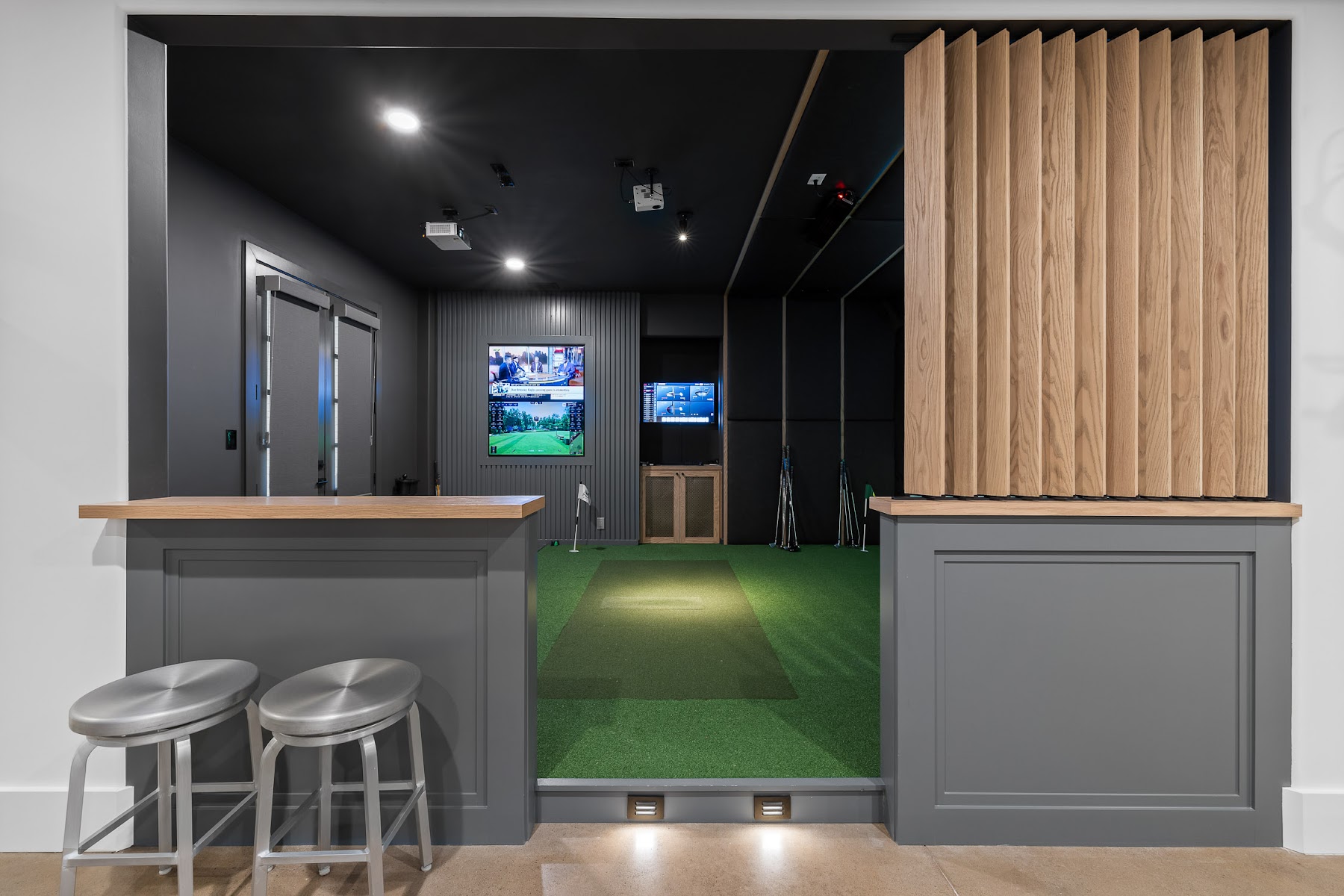
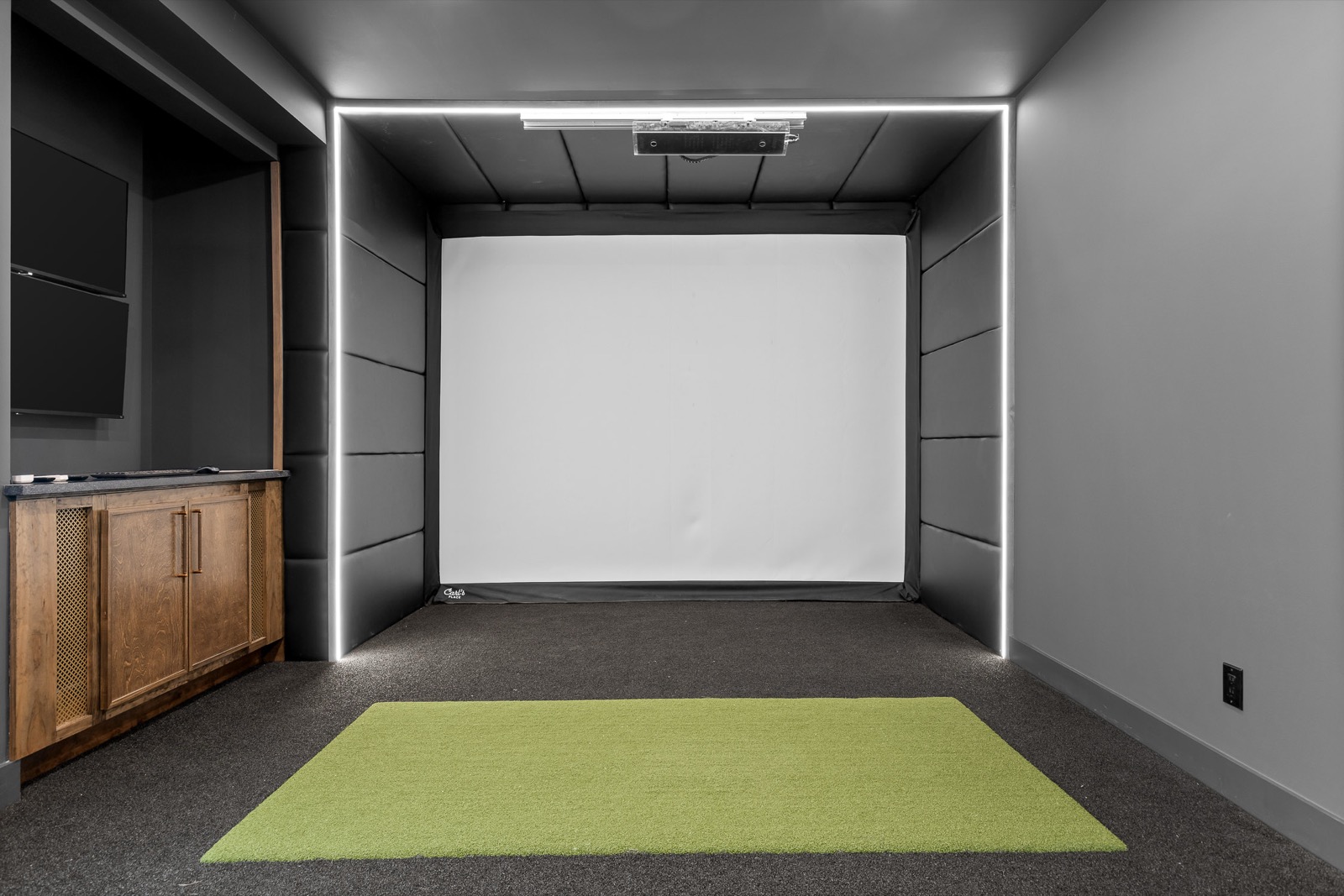
Cliff Stevens: Putting numbers on it, I know it’s a huge range, forgive me, but you’re probably at $50,000 to $150,000 per bay in a commercial setting. Those are two wildly different numbers, driven by all the things we’ve talked about: the fit and finish. We have country clubs and commercial customers that want dark stained, beautiful wood on every single surface, with leather everywhere and beautiful bronze trim.
If we’re going TrackMan with the best fit and finish that you can imagine, you’re probably in that $150,000 range. If we’re going, let’s have a place for guests and members to come in and bang some balls, and we’re not too worried about fit and finish, it’s more in that $50,000 range. I would probably guide most clubs to be in that $75,000 to $90,000 range if they’re trying to build something really nice.
Why is cutting corners on a club simulator room costly?
Corey Ferger: Most clubs are tasked with trying to create an elevated experience. That’s the whole purpose of a private setting. When we’re talking private clubs, my encouragement is always: if you cut corners, members are going to know. If it’s somewhere that members don’t feel they’re getting the authentic answers or having a great experience, they’re not going to use it. It’s all great if you save $10,000 cutting a bunch of corners, but you still spent $40,000 and no one’s going there.
My answer is always: let’s look at the best that you can offer your members. If we need to find some ways to pare that down or get within a budget, let’s work off that. At the end of the day, it should be how we create the best possible experience for the members and their guests.
I see it time and time again, whether it’s on simulators or in other parts of the club experience. You cut those corners, and all of a sudden we see members aren’t using it. And now you’ve just created a very expensive empty room.
Cliff Stevens: Do you want to spend $50,000 on a space that’s not going to actually drive more people spending? Corey always talks about the one more day per month per member.
The ROI story is wildly different. It’s a penny wise, pound foolish type of concept, where we tried to save some money, but now the whole point of it is useless.
Corey Ferger: We can always back that down to some simple math. If you have, say, 400 golf members and you get each one of those golf members up to the club one more time a month, let’s say the average spend for that additional visit is just $50. That’s an additional $20,000 a month that comes into the club, just from that one more time you get them up there. Take that over twelve months or over three years. Those numbers add up very quickly.
Is a simulator room worth more than a course renovation?
Corey Ferger: The era that we’ve moved into within the private club space and the higher-end resort space is that the cost of golf has never been more expensive for the golfer. The club leadership, the owners of these clubs and resorts, and the operators are tasked with figuring out how we continue to elevate that experience. How do we continue to add to it, to help further justify those additional costs?
You can spend $25,000,000 bringing Andrew Green out to completely tear up your golf course. The course is down for sixteen months, and the member experience is definitely going to go up once the course opens back up. But that’s basically three years from getting ready to tear it down to the point where the course is playable in the form that you would want. And the member experience is aided by what? 10%? You spend $25,000,000. You lose access to the course for three years. You lose all the revenue tied to it.
Or you add three or four simulator bays within the clubhouse. You have access to elevated cocktails to go with an elevated, smaller food menu. You have options for more high-touch moments with that member. You elevate that member experience by the same 10%, and you might have a couple hundred thousand dollars into the project. There’s an ROI story to be told with it because it’s revenue generating.
Maybe it’s hard to commit four and a half or five hours to a round of golf, but you can bang out nine holes in an hour in a simulator and have a really great time doing it. You can entertain clients for an hour and a half, hitting some balls and having some good food. When you’re sitting down and analyzing how to add to the member experience, I think simulators are very much at the top of that list.
| Build level | Approximate cost per bay | What it looks like |
|---|---|---|
| Basic | $50,000 | A place for guests and members to come in and hit balls, with little concern for fit and finish |
| Recommended for most clubs | $75,000 to $90,000 | Something really nice |
| Top tier | $150,000 | TrackMan with the best fit and finish, such as dark stained wood, leather and bronze trim |
Frequently Asked Questions
How much does a golf simulator bay cost for a country club?
Cliff Stevens puts a commercial or country club bay at roughly $50,000 to $150,000. He guides most clubs that want to build something really nice to budget $75,000 to $90,000 per bay.
What makes a club simulator bay cost closer to $150,000?
According to Cliff Stevens, a TrackMan bay with the best fit and finish, such as dark stained wood on every surface, leather and bronze trim, lands near $150,000. A basic bay for members and guests to hit balls, where finishes matter less, is closer to $50,000.
Can a simulator room pay for itself at a private club?
Corey Ferger’s example is 400 golf members each making one extra visit a month and spending an average of $50. That adds $20,000 a month in club revenue, and he says those numbers add up quickly over one to three years.
Is it smart to choose a cheaper simulator build to save money?
Corey Ferger warns that members notice when corners are cut. If members stop using the space, the club has created a very expensive empty room. Cliff Stevens calls saving money on a bay that fails to bring members in penny wise and pound foolish.
How does a simulator investment compare to a course renovation?
Corey Ferger compares a $25,000,000 renovation, with roughly three years of disruption and lost revenue, to three or four simulator bays costing a couple hundred thousand dollars. In his view, the bays can improve the member experience by a similar amount while generating revenue.
Edited for length and clarity from a recorded conversation with Cliff Stevens and Corey Ferger.