TL;DR
Investing in a premium home golf simulator or commercial golf simulator lounge requires moving beyond off-the-shelf enclosures and basic Word document estimates. In this discussion, industry experts Cliff Stevens, Tyler Brownfield, and Stephen Enloe detail the high-touch process behind a truly custom golf simulator design build. From initial CAD renderings and prefabricated custom padded wall panels to hands-on client training, a professional turnkey golf simulator installation is built to look as if it was always part of the architectural layout. The panel outlines realistic project timelines, noting that straightforward installations typically take three to four weeks end-to-end once design details are finalized. For discerning homeowners and commercial property managers, evaluating an installer comes down to auditing past projects, visualizing custom finishes upfront, and choosing a dedicated team that handles every technical component—leaving the client with nothing to worry about except teeing up their first swing.
Auditing Proposals: Custom Built-Ins vs. Modular Kits
Cliff: Yeah, it’s all the it’s all the nitpicky stuff, right? Like all the wiring, all the projector mounts, TV mounts, the configuration, right? Like I think I think a lot of times we’ll we’ll hear customers say, hey, I got, I see this proposal Here, it’s a DIY solution or something and it’s it’s less expensive. But I think a lot of times they’re not comparing apples to apples because all those things aren’t always included. But it’s it’s all the things we’ve talked about this whole time: the launch monitor, the computer, the projector, the flooring, the enclosure. And I’d I’d really push people to think about like what are you getting, right? You’ll see some proposals where it says, hey, you’re getting an enclosure, but like, what does that mean?
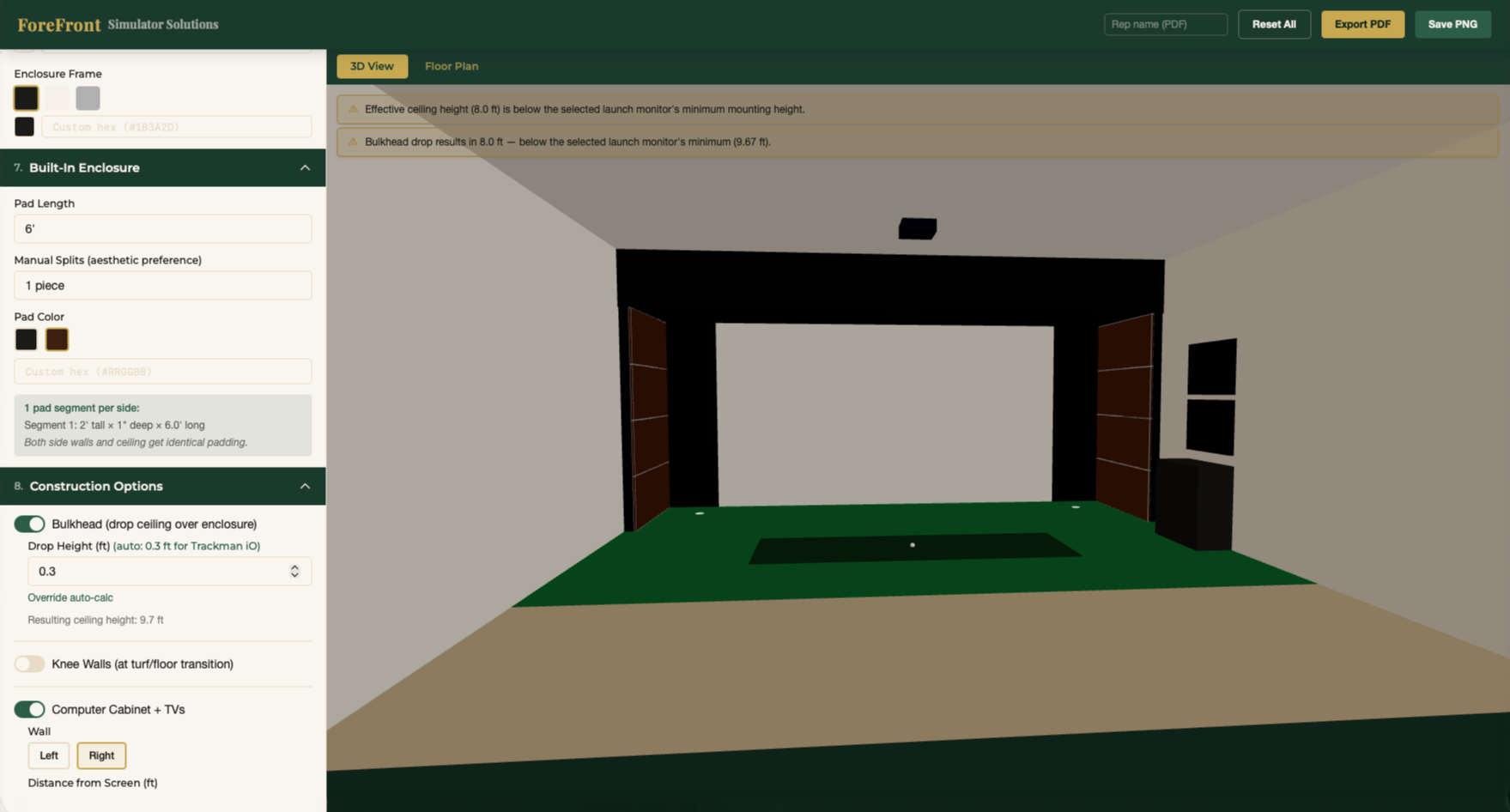
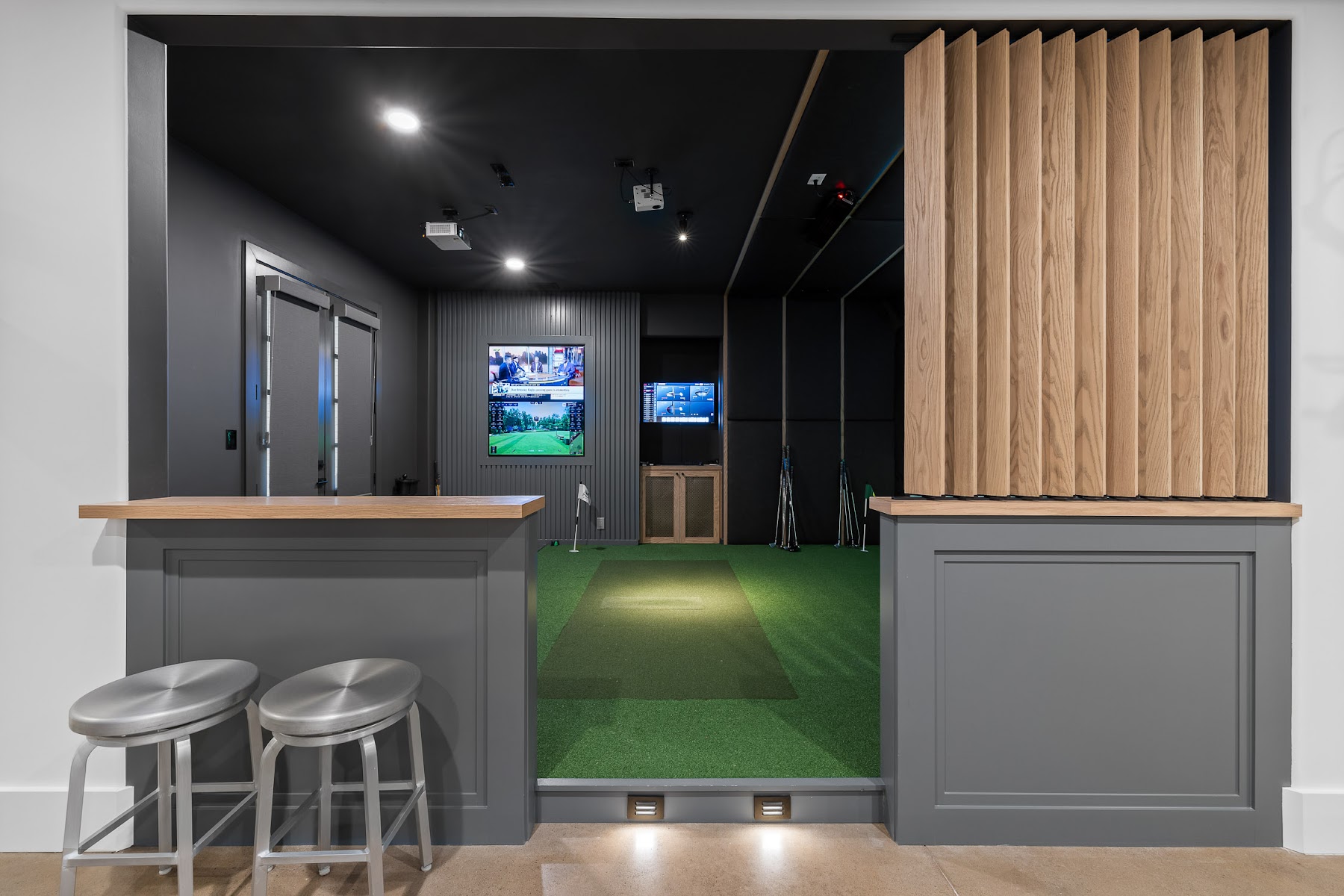
Cliff: Right? Can you show me what I’m getting? Is it a rector set tent that you’re gonna? set up in my house or is it a custom piece of beautiful golf simulator you’re gonna build into my home and make it feel like it was always meant to be there. So I think to me it’s you’re probably not gonna have as many scenarios where it’s like, oh they forgot the projector mount or they forgot the they’re gonna upcharge me for this wiring or something. But it’s probably more and from my perspective it’s more so the quality of what you’re getting. Like how do you put a finger on the quality of what you’re getting and I think that’s where, for us having customers where we can send you to a project where we’ve done and show you something comparable to what you’re getting, show you the rendering of what you’re getting so you can see the look and feel before you get it.
Cliff: Like if you’re just basing your decision off of enclosure built into your house on a on a Word document, like that’s that’s really hard to get a sense of what you’re getting.
That’s where I’d push people to say like what’s the it’s probably more so the quality of what I’m getting, right? If that makes sense. Tyler, I don’t know if you’d want to jump in there.
Tyler: Yeah, I I think you covered all the main things I would think of Cliff it, just to your point, it’s like what’s the difference?, padding means a lot of different things for people. Just inside of that hidden enclosure., we know the quality that we bring with the type of padding that we build. We do it ourselves in our warehouse, we make sure everything is good and it’s custom sized to whatever depth we’re making, or again, whatever patterns we’re making. Versus somebody who’s maybe just buying something off the shelf or through an e-commerce dealer and putting it up there.
Tyler: Maybe it’s not padding that will protect your walls and space, at least where the hidden area is going to be. It’s sometimes it’s hard to discern that without asking the question, or again, as Cliff put it, having a variety of clients where you can go see here’s what forefront or whoever your golf installer is going to be, that they can show here’s here’s what this is going to look like and why it stands out versus some of the other things that on the market.
Stephen: Yeah, no, I think that’s super helpful information for people. And then the last question of the day for you guys is how long does it take to design and build a custom home golf simulator room? Tyler, you want to jump in?
Tyler: Sure. Yeah, I can jump into that. It’s always a big it depends. But, if we’re thinking about a fairly straightforward simulator and a design that the client is pretty well set on or has a decent idea., you usually we can turn around an initial design with an iteration or so, probably in about a couple of weeks.
And then usually for a build, it’s somewhere between one to two weeks, again, depending on the overall complexity. You could look at it almost end-to-end if everything was lined up and the client has the time to go through the design process, probably somewhere around three to four weeks is what we would typically do.
Tyler: Again, it always can take longer if there’s, we typically our client. Are typically fairly busy folks. When we need time to confirm some design pieces or they really want to have more intentional input on the design process, then it usually draws out a little bit longer. But yeah, typically I would say somewhere between three to four weeks end to end, between design to actual build, is a pretty realistic time frame for us when clients are ready to move forward pretty quickly.
Cliff: Yeah, and the actual the actual build time is pretty typically pretty quick. We sent an electrician. And or we have a predetermined electrician we work with all the time. Send them in to do all your pre-wiring, your low voltage or electrical. That’s half a day of work. And then our crews come in for the core golf simulator build, two to three days of work, maybe four. And then we send in patch paint cleanup after, and that’s another half day issue of work. Could squeeze that all in within a week, but it might spin out to two weeks of actual work in the home.
Visualizing Your Space Through Photorealistic Renderings
Cliff: And then, more complex builds can obviously take longer, right? If we’re doing A bar and bathrooms and other types of finishes in your space that can take a that can be a bit of a longer build. And then something like a golf shed. Again, longer design time frame, longer build time frame. That’s probably looking, we did one recently where we did the whole front design through the build in probably six to eight weeks. But it’s probably in like the six to twelve, fourteen week range if you’re doing a golf shed structure in a backyard. Yep.
Stephen: Yeah., honestly, even that six to eight. Weeks is that’s quick for an entire building. That’s that’s insane.
Realistic Timelines for Turnkey Simulator Builds
Stephen: Well, awesome guys. That really concludes this list of questions that people are having today. But I think it’s been super helpful. And I think a lot of the information that you guys shared shows a lot about the quality of work that you guys do as well as how much you guys really care about your customers. Thanks so much for hopping on with me today. And I hope that for anyone who’s looking at this is that it’s helpful information.
Cliff: Awesome. Thanks Stephen.
The Handoff: White-Glove Onboarding and Training
Tyler: Thanks, Steven.
Comparison at a glance
| Phase | Custom simulator room | Backyard golf shed |
|---|---|---|
| Design | About 2 weeks for initial design plus an iteration | Longer design window than an interior room |
| Electrical pre-wire | Half a day | Part of the full structure build |
| Core simulator build | 2 to 3 days, occasionally 4 | Included in overall shed construction |
| Patch, paint, cleanup | Another half day | Included in overall shed construction |
| Total end to end | 3 to 4 weeks | 6 to 12 or 14 weeks; one recent build finished in 6 to 8 weeks |
Frequently Asked Questions
How long does a custom golf simulator installation take from design to completion?
For a straightforward residential or commercial golf simulator with finalized design preferences, the end-to-end process typically spans three to four weeks. This timeline includes initial architectural iterations, custom fabrication of enclosure components in-house, white-glove build-out, and final system training. Projects requiring extensive structural adjustments or highly detailed bespoke finishes may naturally extend this timeframe.
What is the difference between a DIY golf simulator kit and a professional custom golf simulator build?
Modular or DIY kits rely on standard-sized enclosures and exposed framing that often look added-on rather than integrated into a room’s architecture. A professional custom design build involves tailored carpentry, acoustic padding cut to exact room dimensions, hidden cabling, and premium aesthetic finishes. The result is a seamless luxury golf simulator room built directly into your space with commercial-grade durability.
How can I evaluate the quality of a golf simulator installer before signing a contract?
Look beyond basic text estimates or itemized pricing spreadsheets. Reputable installation teams provide detailed 3D design renderings that show exact dimensions, lighting placements, and finish textures before work begins. Additionally, established builders can show you completed local installations or comparable past projects so you can physically evaluate the craftsmanship and fit-and-finish.
How much involvement is required from the homeowner during the simulator build process?
Client input is primarily focused up front during the initial design consultation, material selection, and layout approval. Once the design is locked in, a full-service turnkey installation team manages all fabrication, electrical coordination, hardware mounting, and software calibration, requiring minimal effort from the client until the final walk-through.
What happens after the physical installation of a home golf simulator is finished?
A premium installation finishes with a comprehensive handoff and onboarding session. Technicians walk you through operating the software, switching between target practice and course play, calibrating launch monitors, and troubleshooting basic controls to ensure you can confidently use your new simulator space to its fullest potential.