TL;DR
Creating a luxury golf simulator room requires far more than assembling off-the-shelf components; it demands meticulous pre-planning and intentional golf simulator design build execution. A truly bespoke installation seamlessly integrates advanced technology into the surrounding architecture of high-end residential or commercial spaces. Key construction details—such as flush-recessing hitting mats into putting turf, hiding power outlets near elevated projectors and launch monitors, and running internal conduit for future wire upgrades—ensure the space looks intentionally designed rather than retrofitted. Beyond aesthetics, functional considerations must align with the user’s specific performance goals. Selecting the right launch monitor and software integration enables advanced shot data export, webcam setups for sanctioned online league play, and multi-use versatility. Whether adapting an existing room alongside an interior designer’s mood board or planning new construction, executing fine architectural details like custom millwork, tailored padding shapes, and optimal room paint tones ensures a refined, turnkey indoor golf simulator lounge experience that retains its value and performance over time.
Intentional Architectural Details in Custom Golf Simulator Installation
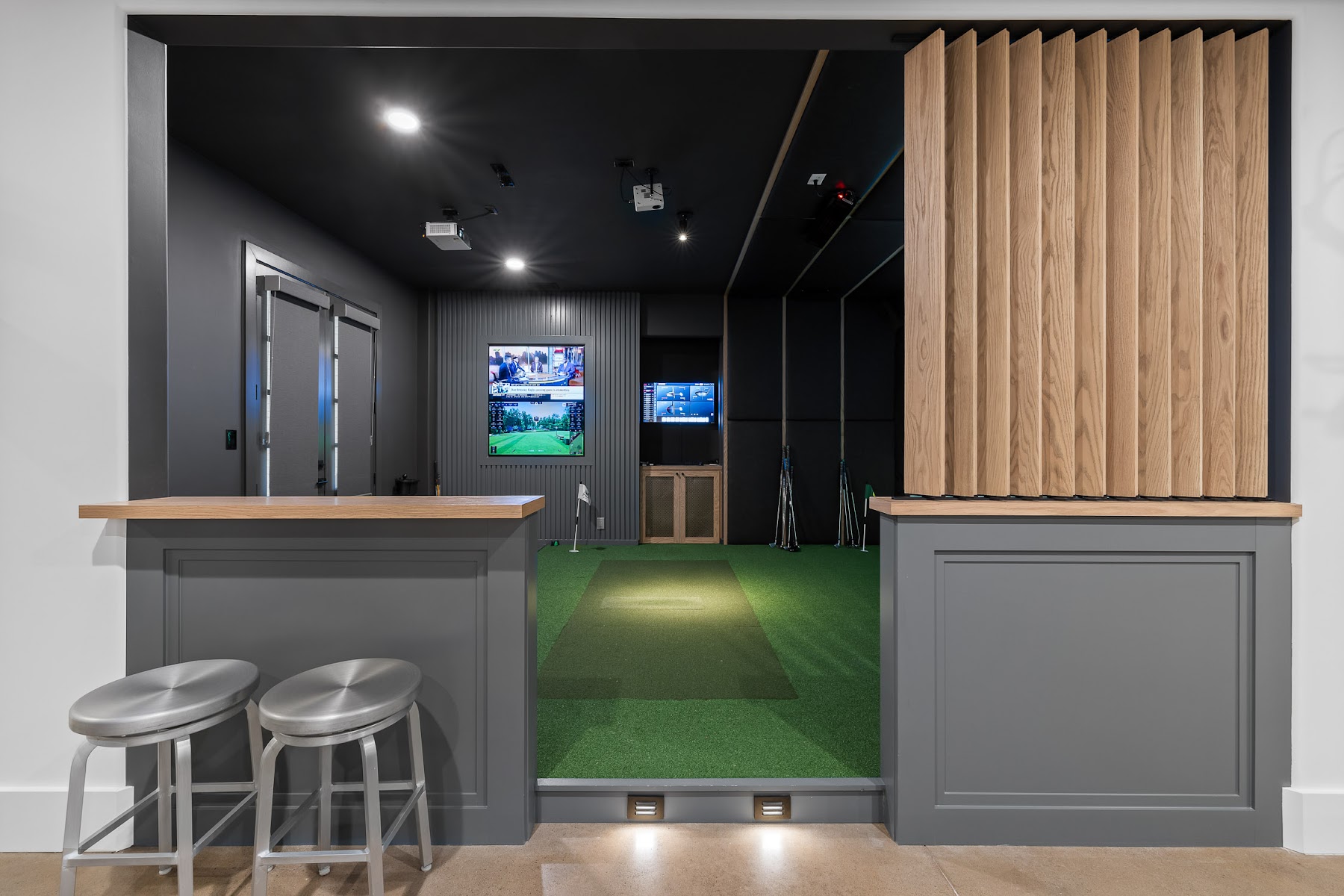
Tyler: We’ve done enclosures that are straight up and down. We’ve done them that are diagonal, that have pony walls built in. It’s it’s what’s the overall architectural feel, design feel in the space, and do we incorporate it there? And then I’ll I’ll let Cliff speak to this, but the other side of this is sometimes folks want that golf simulator to stand out on its own. Cliff, you can might maybe speak to more of sometimes it’s intentional not to match the rest And really make it stand out and pop.
Cliff: Yeah, yeah. Yeah. And honestly, we’ve seen some customers do some very non-traditional golf simulators, right? We had a customer that had a very traditional home and they didn’t want putting turf all throughout the room. They put a nice rub down in the middle of the room, and we put the golf the hitting mat on top of that. It doesn’t always have to look like the same old golf simulator. And to Tyler’s question, yeah, sometimes you want your golf simulator room to totally stand out, right?
Maybe you have a traditional contemporary house and you want your simulator to be super modern and funky and we can accommodate that, right? And it’s, it’s just a design decision for you and your home.
Cliff: How do you want this thing to feel? Do you want it to feel like it’s part of your house, or do you want it to feel like this cool modern piece that just really stands out and doesn’t look like anything like the rest of your house? So those are all options we have. And again, we can make it look really modern. We can do geometric patterns in the pads if we wanted to, LED lighting everywhere. So yeah, all sorts of options to. Take it in a totally different direction. And I love the idea of, it’s a sim room. Let’s have fun with it. Let’s make it really cool. Let’s make it stand out and not fit in with the crowd.
Software Integration and Technology Considerations for Serious Golfers
Stephen: No, I think when you were even talking about the design work aspects beforehand, I was thinking that same exact thing. I was wondering if you guys were gonna go into both sides of that with this question. I’m glad that you did though. What technology decisions matter most for serious golfers building a home simulator?
Cliff: Yeah. As far as a technology, the technology decisions, speaking about a brand agnostic and just the features that a customer should be considering, I go back to what are we trying to achieve, right? So are you a former professional golfer that’s trying to stay top of his game and work towards playing on the champions tour? You might have very different requirements than, a dad that’s trying to get his junior into golf and create a family entertaining space, right? So again, we always push our clients and orient their conversation back towards what’s our goal, what are we trying to achieve? So some of those technology decisions would be things like what launch monitor do I want? what launch monitor do I want? so how accurate is it measuring ball data and club data, right? How many metrics is it going to give you from across both of those?
Cliff: And do you need things like club stickers to achieve them? Right. That’s a very important thing to help you in your decision about a launch monitor, as well as the cost, right? What’s our we’ve got to balance the features we want and the budget because, there’s there’s very significant budget changes as we change across some of those features. Similarly with the launch monitor, I would talk about swing cameras, right? Are you really trying to work on your game? Are you trying to work on getting lessons in your golf simulator?, I personally do that. There’s features like AI swing trainers that are coming out and starting to get better and better. Do we want to integrate swing cameras so you can have an AI swing trainer and get golf lessons? project. Projectors, right? We need to think about 4K versus 1080p.
Cliff: That’s obviously very driven, can be driven by budget. There’s a big impact there. How bright do we need the projector? Do you have a lot of ambient light in your room? In which case we would push you towards a higher-end projector that has more lumens so your screen doesn’t get washed out. And then other features. There’s other amazing features we can add to a golf simulator. We can add shooting simulators, tactical shooting simulators where you’re using real, AK or AR-15.
And Glocks and you’re shooting bad guys on your screen. We can add a multi-sport simulator. You’re throwing frisbees, kicking soccer balls. We’re seeing a high-end disc golf simulator coming onto the market where you can practice throwing frisbees and playing on a golf course. And it’s similar to the golf simulator from an accuracy and value perspective. And then, the gaming PC, it’s the heart of the operation, and we obviously spec that in accordance with all the other features you pick.
Cliff: It’s like What’s important to you, and then, we’ll select the PC based on that. And then I’d say, are you also trying to use it as a multimedia room? Do you want to be able to put hook an Apple TV up and have integrated speakers so you can watch a movie or have kids playing games on it or an Xbox, right? Like we can it can be super multi-purpose, right? We’ve got a computer, we’ve got a projector, and we can make it very multi-purpose with all those things I just talked about. I said a lot, Tyler. What did that necessarily on the serious golf?
Tyler: For front, other things we would typically consider, and Cliff alluded to this as well too, but, across the different launch monitor brands, the software, the courses they include. Does it include the types of courses either maybe local to you or that you play? How well does it integrate with other third party simulator course software that might also have some other courses you want to play or some training features that you want to track and compare against over time. So I think that becomes another big part, especially for serious golfers who maybe have specific courses. They can’t play in real life or they haven’t made that trip yet, but they still want to be able to do it in a virtual experience. Again, like, certain software platforms have more community developed courses.
Tyler: Your local course, your local country club might be on that platform and you want to get ready for your next member, member, m member guest or, club tournament. You get the extra reps in that way. The last piece I would say again back for the serious golfer is, if you want to participate in more online golf leagues through different platforms, typically you need to have a webcam set up and some other features so that you’re able to record your rounds so you can get a approved and make sure you’re not cheating., there’s some other considerations around that, we can help factor in again based on what experience the client’s looking for.
The other I guess the other thing I would say I left out the swing cameras are great.
Cliff: There’s also balance mats, right, that show you how your weight is shifting during your swing. And again, a serious golfer that used to be a five, ten, fifteen thousand dollar add-on in a in a golf simulator. They’re very affordable now. And again, you can marry up your swing cameras, your balance mat, and you can see your swing, how your weight’s shifting. You can even then send those videos to your golf coach and say, Hey, how am I doing? Am I doing what you asked me?
Cliff: And get good feedback that way. Really good. Stuff there. And then there’s also a lot of really good statistical analysis you can do. You can export your, your shots, your shot history to there’s certain software you can you can export it to, analyze it, get good feedback, see how you’re you’re either improving or changing over time. Just really, you can again the sky’s the limit and you can take it almost as far as you want.
Stephen: That’s honestly again from like an outside perspective, that’s so cool how versatile these spaces Can be, and even with just with the same technology, how many different uses you can have for them, even within golf, not even taking into account all these other factors. That’s awesome. Going on to the next question, what are the biggest mistakes homeowners make when they’re planning a custom simulator room?
Cliff: Yeah, I think sometimes trying to force a simulator into a room that’s not a good fit, right? We can design a simulator into a lot of rooms and accommodate a lot of different, in a lot of different Issues, right? We can work around soffits, we can move a gas line, we can, work around HVAC ducts and vents and things like that. We can put in a beam and raise the ceiling, right? There’s there’s all sorts of ways that we can help make a room more accommodating for a golf simulator. But I would say one, to me, putting it in the wrong space, and we really try to push back on a client and guide them if they’re going to put it in a space we don’t feel is right.
Harmonizing Simulator Aesthetics with High-End Interior Design
Cliff: And then two. Probably not future proofing enough, right? Not thinking about what might I want down the road. We push for this all the time. Hey, we’re gonna put in conduit to run from this location to your computer just in case technology changes over time and we need to run new wires. But, trying to go a little too small and not think about how they might use it in the future. Because once we’re in there doing work, it’s the time to get those things done and and get them in place so that we can plan for the future. But Tyler, I don’t know if you have other thoughts on mistakes you’ve seen.
Comparison at a glance
| Factor | Simulator kit | Custom-built room |
|---|---|---|
| Room requirements | Needs a square room with no obstructions or challenges | Works in less-than-ideal spaces, sloped ceilings, irregular layouts |
| Soffits in the room | Enclosure must sit entirely under the soffit, shrinking the screen | Uses the full space to maximize screen size |
| Materials and color | Limited to what ships with the kit | Any material, color or fabric; pads built in-house, embroidery available |
| Hitting mat and turf | Mat laid on top of putting turf | Mat recessed and cut into the putting turf for a flush finish |
| Feel in the home | Described as a rector set or tent set up in the room | Built in so it feels intentional and part of the house |
Frequently Asked Questions
How do you seamlessly integrate a home golf simulator into an existing room’s design?
Integrating a home golf simulator into an existing room requires careful pre-planning around both technology and aesthetic finishes. Professional installers work alongside mood boards or interior designers to match existing millwork, stains, and color schemes, such as using dark paint tones optimized for screen contrast. Details like flush-recessing hitting mats into surrounding turf and concealing outlets near elevated launch monitors ensure the space feels elevated and intentional.
What architectural and room details matter most for a luxury golf simulator room?
A luxury golf simulator room focuses heavily on clean architectural transitions and invisible cable management. Essential details include placing power sources directly adjacent to projectors and launch monitors to avoid visible cords, using pre-installed conduit inside walls for future hardware updates, and customizing enclosure padding shapes to complement the room’s geometry. Flush-mounted turf and custom cabinetry for computer equipment further elevate the installation above generic kits.
What launch monitor features should serious golfers look for during a golf simulator design build?
Serious golfers should evaluate launch monitors based on third-party software compatibility, data export capabilities, and league play requirements. If you plan to participate in sanctioned online leagues, the system must support webcam integration to verify swing data and rounds. Furthermore, choosing hardware that seamlessly exports shot history for deep swing analysis ensures the simulator functions as a legitimate game-improvement tool.
How do you future-proof a custom golf simulator installation as technology evolves?
Future-proofing a custom golf simulator installation involves running dedicated conduit behind walls and ceilings from the computer hub to screen, projector, and sensor locations. Because cable standards, camera sensors, and launch monitor hardware change rapidly, internal conduit allows technicians to pull new wiring without tearing into drywall or custom cabinetry. This structural foresight keeps the room adaptable as third-party software and hardware advance.
Can a commercial golf simulator space be customized to match existing interior designs?
Yes, high-end commercial golf simulator projects are routinely tailored to match the surrounding facility’s architectural standards. Custom design builds incorporate bespoke millwork, tailored sound-dampening wall padding, and specific stain finishes that reflect the brand or club’s aesthetic. By coordinating with interior designers during the planning phase, commercial lounges achieve a cohesive, premium look that disguises heavy-duty impact materials within high-end finishes.