TL;DR
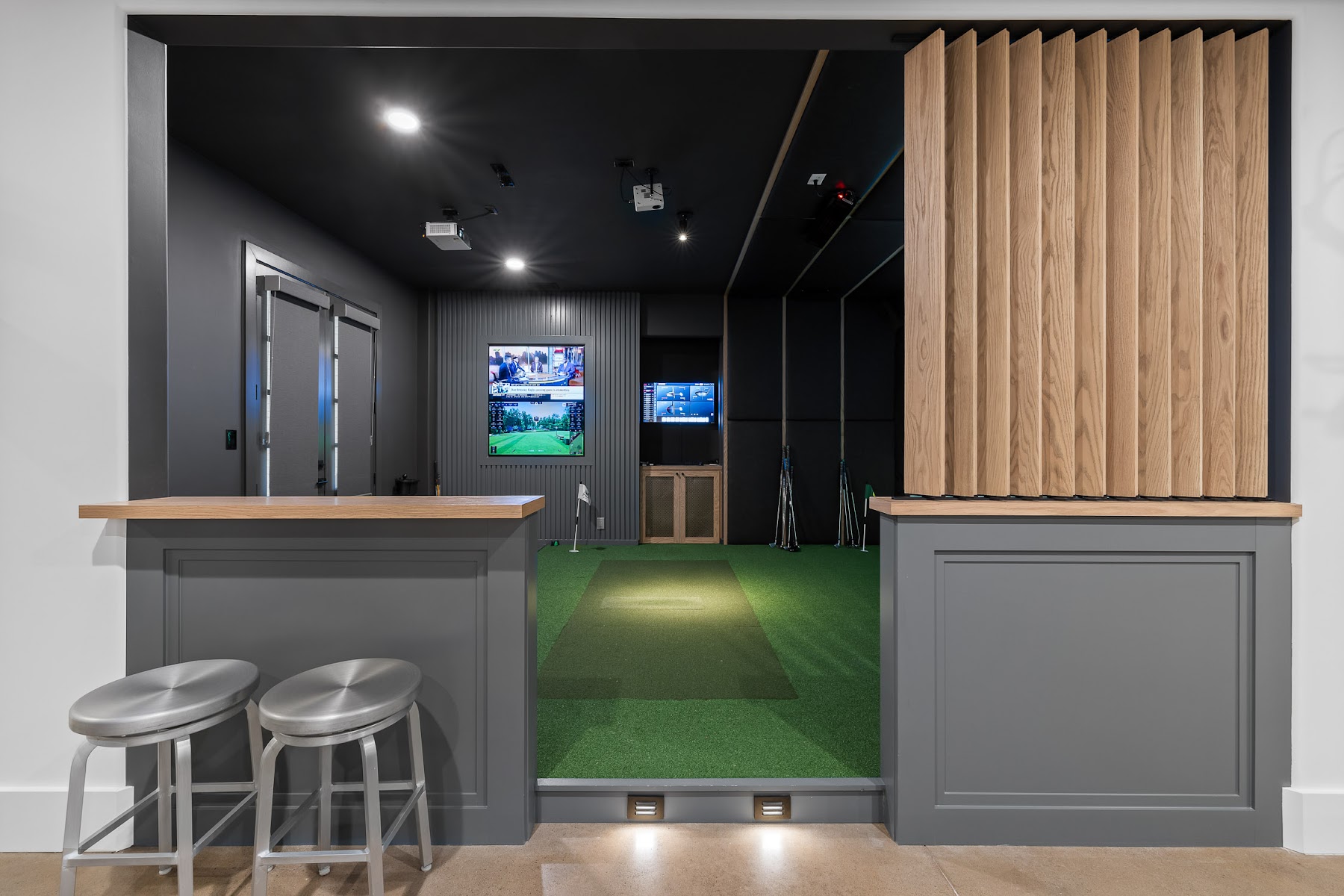
Designing a dedicated home golf simulator requires moving beyond off-the-shelf setups toward an intentional, custom golf simulator design build. Early site consultations often reveal that an alternative room layout or elevated architectural plan provides a vastly superior entertaining experience for guests and family. Key technical considerations include hardware selection—specifically transitioning from portable floor units to high-performance, ceiling-mounted launch monitors—and assessing the long-term software update trajectories of top manufacturers. Beyond technology, room requirements play a critical role in long-term satisfaction. Dimensions such as a 12.5-foot room width dictate specific tracking hardware configurations or mechanical sliders to maintain accuracy. Furthermore, acoustic engineering must address both high-frequency driver impact and low-frequency screen thuds to prevent sound transmission to upper living areas. Incorporating specialized drywall, insulation, and acoustic panels manages room reverberation, while dedicated electrical circuits ensure amenities like dry bars and mini-fridges operate seamlessly alongside high-performance gaming hardware.
Transitioning to a Custom Golf Simulator Design Build
Tyler: Yeah. Those are yeah, so planning for a space that’s less than ideal is usually one of the biggest ones. And I think I said in an earlier question, that’s that we have multiple examples where gone and done our actual initial site visit with a client, help them look at spaces and determine some alternatives that were a much better overall fit for the type of experience they’re looking for. I wouldn’t maybe call I wouldn’t maybe call this a mistake, but, sometimes folks will start with a more basic kit setup first. And that gets them the bug of like, oh, I really like simulator golf. And then they transition to a more custom.
Tyler: Again, we’ve had multiple clients where they had an existing setup, and then they realized they really want to move to something that was much more intentional or again better for hosting, entertaining a larger group of folks., so they could be the spot, every week, or it’s the place that their kids want to come to. Again, I wouldn’t necessarily call that a Mistake per se, but that’s a natural progression we’ve seen folks make of, they start off doing things and then they eventually transition to let’s do, again, something more custom, more intentional, and usually upgrade to a ceiling-based launch monitor versus a floor one as well.
Cliff: I would I would add really quick, and, this might sound like a little bit of a commercial, but it’s but it’s genuine and honest. Going with a golf simulator provider that doesn’t have experience, right? I can’t tell you the number of projects. We’ve done where we come in and fix somebody else’s work, where maybe it wasn’t designed right, the balls flying back and hitting windows behind the golfer. We’ve seen giant ball marks in the walls back behind the golfer. We’ve come in and fixed many golf simulators where somebody else came in and built it, they said they had the experience to do it, and just weren’t qualified, didn’t design it right, and then the customers left with an expensive item that they really can’t use.
Cliff: So yeah, and just ask the question.
And right, how many golf simulators have you done? Can you show me examples of your work? Can I get a reference?, we’re always happy to provide examples of our work, put you in touch with a client and let you ask all the questions you want about how did the experience go, what’s the product like, go visit it, right? You want to see people’s work before you, sign off and give them your money to go build you a golf simulator.
Stephen: No, and I and I appreciate the preface of that answer too, of, it it may sound like a commercial or not, but I think honestly that’s the that’s the right that’s the right advice for people, for anything you want to be able to verify what they’re able to do and I think that it’s a really it’s a really helpful answer thinking about even just the two things that you guys said before about realistically mistakes being made about future proofing about being able to expand on this because specifically even just the answers we gave before I don’t think a lot of people realize how many different things that you can do with it and how versatile it can be and how far you can take it.
Stephen: And so I think that’s why it’s really useful for us to get these answers out there. It’s because unless you guys are the ones telling them if the experts, then how are they going to know? So that’s awesome. Super helpful. So my next question is I think very helpful for the next steps of once people have done these this research and they understand a little bit more about it. But it’s how should home Owners select specific launch monitor and additionally, what features should they be making sure that they consider in that process of selecting that launch monitor?
Cliff: Yeah, sure., Tyler, I think I spoke about this a little bit.
Maybe share your perspective and then I can chime in.
Tyler: Sure. Yeah, I’ll I’ll probably hit some of the same points because you’re right, you brought them up, but, it’s it’s really looking across the platforms on the ba based on the experience. If you’re more serious golfer, you’re probably more interested in knowing. What actual ball and or club metrics are tracked., whether or not there’s special stickers that are required under clubs in order to do it. How is the overall software ecosystem and accessory ecosystem across different brands, whether it’s in brand or third party? So that would be things like the swing camera, the balance mats, some of the AI training and AI video type capabilities. And again, what other What other third party software can those launch monitors interact with? And you could also say what’s been the overall trajectory of the launch monitor manufacturer, how frequently are they making updates, refreshing their software, those types of things would be a lot of core considerations that yeah, we help our clients think through., a lot of clients that come to us may not even be the most the best golfers, right?
Tyler: They might be, plus 10, plus 15 plus 20 handicaps, but they love golf and they may not know the simulator space. We help them think through a lot of those different considerations in regard to their space and what experience they’re looking for, and also trying to find the best, economical option for them within their budget that meets checks off the majority of the things on their list. But yeah, go ahead, Cliff, if you’ve got some other
Launch Monitor Technology and Room Dimension Tradeoffs
Cliff: Yeah, budget’s gonna be a big driver, right? Like there’s certain features you want, but it, even the more budget-friendly options typically offer. For some form of those features. Yeah, budget’s certainly a driver of that selection. I would the only thing I might add would be how big is the hitting area, right? Every, ceiling mounted launch monitors, floor-mounted launch monitors, that’s certainly a consideration in your space. But for a ceiling-mounted launch monitor, the size of the hitting area could determine: is it a good fit for you in your space or not? Right. If you’ve only got a 12 and a half foot wide room and launch monitor that only sees a ball and a six inch by six inch area isn’t going to be super helpful for you unless we put it on a slider, right?
Cliff: So again, some other another can other things to consider when you’re thinking about a launch monitor.
I think that covers it pretty well. Tyler touched on the open versus closed ecosystem. To me that’s really important as a buyer, right? I I would like, I personally like to have the option of trying a different golf simulator software that’s coming on the market. Right. There’s some that are coming out like who knows the simulator software I use today may be antiquated And there may be a new great one two years from now. And I want to switch to that. Me personally, I want that option to be able to try new software, integrate different technologies, and not be locked into just one ecosystem.
Tyler: I this is less common for us, but Cliff mentioned, floor versus ceiling based launch monitors. But, again, for more serious golfers, some of them like the ability to also take their launch monitor onto the course and take it to the driving range and get their numbers outside.
So that typically comes with more of the floor-based launch monitors that are battery enabled. Again, just depending on the type of golfer, that’s another consideration that we may make as part of it.
Tyler: Ideally, indoors, we typically like something that’s ceiling mounted and camera based. But again, it’s that give and take of oh, I want the added portability. I want to be able to take this out to the course, get my numbers when I’m on the driving range, but also bring it back into the simulator setting. It’s all that give and take of what’s most important for them and then helping them find the right option. Yep.
Stephen: Yeah. And I think it’s it’s so interesting that so many of these in these answers tie together because it even goes back to like almost like the future proofing that you were talking about before as well.
Tyler: Yep, 100%.
Acoustic Engineering and Sound Isolation for Simulator Rooms
Stephen: Yeah. We’re getting closer to the end here, but we do have a few more questions. The next one that we have is what electrical light. Lighting, flooring, and acoustic considerations matter in a home golf simulator.
Cliff: Many matter. There’s so much there. And that’s, that’s why we have a dedicated design team because Tyler or another one of our team members might be involved in the sales process. They’re sharing information with our design team and you’ve got to think about all those things. Like you said, it’s just it’s all interconnected. And if we change a decision about a feature that we want that might change our electrical or Our low voltage wiring plan, right? So all of our simulators, we build out a full electrical and low voltage wiring diagram. That’s super helpful for our crews, for our electricians on our team. It’s also helpful for a builder if we’re integrating with a builder who’s building a house and then we’re going to put the sim in., electrical, super important.
Electrical Planning and Future-Proofing Luxury Amenities
Cliff: Tyler said it earlier, right? We want electrical outlets near the technical components that we’re going to have. We don’t have wires running all over the place., we want to embed all of the low voltage wiring into The walls, take them to the right place from the right place. We want to put conduit in there so that we can, run wires in the future if something ever gets damaged or technology changes. Additionally, like lighting similar to electrical. We want to think about the ambiance of the room and not have a ton of ambient light. We like to have LED lights that we can put on dimmers in lots of nice places. Even something like a pin light, right?
Cliff: A very focused light. That shines down on the golf ball when you’re about to hit it. We’ll incorporate those into sim sometimes on a switch, so and a and even on a dimmer. So you can be playing with the lights off, you’ve got the glow of the screen, you’ve got your nice little LEDs and your pin light, nice dark room, nice ambiance, but you can still see the ball and it and it’s just a nice setting. Maybe I’ll pop pause there, Tyler. You if you want to jump into the acoustics, like insulation.
Tyler: Yeah, let’s talk about acoustics. Again, depends on where the sim space is, especially oftentimes we’re in a basement so you’ve got a first floor above you and depending on what that what’s on that first floor whether it’s animals or spouses or kids they don’t necessarily like to hear the people in the golf sim especially if you’ve got multiple golfers there so extra consideration for putting more insulation and potentially drywall sauna pan things like that in order to help with that sound transmission so you can limit the amount of sound that’s Going up there just because you’ve got the h high frequency pings from hitting something like a driver, but also the low frequency from the thud on the impact screen.
Tyler: Just overall sound transmission is a pretty key piece.
But even if it’s in just enclosed or separate space, the reverberation inside of the room. Sometimes we’ll put acoustic treatment on the actual walls itself or acoustic panels just so we can keep the reverberation that the echo down inside of that room, even if sound transmission between levels isn’t necessarily an issue. And then going back to oh go ahead Cleveland.
Cliff: It’s super quick on that, right? Even adding a door, right? Like so my golf simulator is right back here behind me. We added a door right here that goes up the stairs to the main floor. Again, just like it was an open stairwell. That’s a trend in newer houses. Everything’s open and that wasn’t going to fly. We added a door in. Super simple. Yep. That helps., my wife says, hey, will you close the door? And that, that solves the problem. And I can keep on playing golf in my basement, right? Yeah. Nice.
Tyler: I was just going to add on some of the electrical con considerations of the again when we go through the planning and think about the electrical load as well too., ideally we want to have a dedicated circuit just for the simulator components. But again, if you’re adding things like maybe a dry bar with a mini fridge, and, those are other additional electrical loads that we want to make sure we have the Enough circuits, enough amperage so that when you go and turn everything on, all of a sudden you don’t have a short or you can only turn on some things and not all those pieces. I think if if you don’t do a lot of that pre-planning or have somebody you’re working with that’s helping you think through that, that’s that’s an easy miss if you don’t have much experience in that space.
You did also ask about flooring, right?
Tyler: So we I mentioned earlier we put putting turf down in most of our rooms. Typically going wall to wall with putting turf, but then we’ve got transition. To other flooring we have to plan for. You may be doing wood flooring and you want to inlay the putting turf into it, which is an awesome look. We can do putting turf with a fringe border around it, which looks amazing. We’ve done awesome little like putting greens with rough and sand traps, fake sand traps built out of putting turf., again, the sky’s the limit, and it’s stuff that we talk you through as a client and plan for. And again, just bring some of that creative thinking to. Of how do we create something awesome that’s going to stand out and really highlight those little details like we talked about before?
Comparison at a glance
| Factor | Ceiling-mounted (camera-based) | Floor-mounted |
|---|---|---|
| ForeFront indoor preference | Typically preferred for indoor simulators | Chosen when portability matters |
| Outdoor use | Fixed in the room | Battery enabled; can go to the course and range |
| Narrow-room constraint | Hitting-area size decides fit; a 6-inch by 6-inch window fails in a 12.5-foot room | Positioned beside the ball rather than overhead |
| Workaround for tight width | Mount on a slider so it can be moved for lefties and righties | Repositioned manually per golfer |
| Upgrade pattern | Common upgrade when moving from a kit to a custom build | Often the starting point for first-time owners |
Frequently Asked Questions
What room dimensions are required for a custom golf simulator installation?
While ideal spaces offer ample clearance, narrower rooms around 12.5 feet wide require precise planning and specialized hardware configurations. In tighter spaces, standard launch monitors with small catch zones may prove restrictive unless installed on mechanical sliders or paired with overhead tracking units. A professional site assessment helps evaluate ceiling height, depth, and width to ensure safe swinging and accurate ball tracking for both right- and left-handed golfers.
Why should I choose a ceiling-based launch monitor over a floor unit for a home golf simulator?
Ceiling-mounted launch monitors keep the floor clear of obstructions, creating a cleaner aesthetic and a safer environment for entertaining groups. They eliminate the need to reposition hardware when switching between right- and left-handed players, making them the preferred choice for custom golf simulator installations designed for hosting. Additionally, overhead units are less susceptible to accidental impact and seamlessly integrate into high-end room designs.
How do you manage soundproofing in a basement home golf simulator?
Effective sound dampening requires addressing both high-frequency sounds, such as the ping of a driver, and low-frequency vibrations caused by impact screens. Specialized drywall, sound-isolation boards, and dense insulation prevent noise transmission into living spaces above. Interior acoustic panels are also utilized within the simulator bay to eliminate echo and control sound reverberation for a refined visual and auditory experience.
What electrical considerations are necessary for a turnkey golf simulator space?
High-end simulator spaces demand robust electrical planning beyond powering the golf tech itself. High-performance gaming PCs, projectors, audio systems, and supplemental amenities like dry bars, wine fridges, and ambient lighting draw significant power. Dedicated electrical circuits and proper amperage management prevent breaker trips and ensure all audio-visual and beverage appliances run simultaneously without interruption.
How do I future-proof my commercial or luxury golf simulator room?
Future-proofing involves selecting launch monitor manufacturers with proven track records of frequent software updates and hardware longevity. Additionally, designing the physical enclosure with adequate space, scalable wiring conduits, and versatile mounting infrastructure allows you to upgrade cameras, tracking hardware, and software platforms seamlessly as commercial-grade golf technology evolves over time.