TL;DR
Cliff Stevens, founder and owner of ForeFront Simulator Solutions, puts the starting point for a commercial golf simulator lounge at about $50,000 to $100,000 per bay. A two- or three-bay venue without a bar or restaurant can run $150,000 to $250,000 to build out, and most independent lounges open with two to five bays. He says the right bay count and budget come from a detailed business plan built on rent, pricing, occupancy and costs, not from the construction drawings.
- A two- or three-bay commercial simulator business without a restaurant or bar might cost $150,000 to $250,000 for a full build-out, before leasing, insurance and payroll.
- About $50,000 per bay is a general starting point for a commercial lounge, and $50,000 to $100,000 per bay is a reasonable range before adding extras. A five-bay facility is likely a minimum of $250,000.
- Top-end TrackMan units, high-end finishes, bars and wellness amenities push budgets up. Some ForeFront clients are spending $3,000,000 to $5,000,000, and one hotel project is in the $20,000,000 range.
- Most independently run lounges start with two to five bays. Stevens suggests starting smaller in a space that could hold eight or 10 bays and expanding as membership grows.
- Rent sets the floor for bay count. At $8,000 a month in rent, two bays probably won’t cover it unless rates are exorbitant.
- A budget should cover build costs, recurring software, insurance, food, payroll and other employee costs. Commercial leases usually carry five-plus years of personal guarantees.
What does it take to build a premium golf simulator lounge?
Cliff Stevens: We could jump in and start talking construction, but I would take a step back. Similar to building a simulator in somebody’s home, what’s the vision? What are we trying to achieve? A lot of people say, oh, I want to go build a golf simulator bar and lounge. It sounds like a cool idea. It sounds fun. It sounds like a way to make money, but do you really have a business plan? Do you have a plan on what the financials are going to look like, what your rent is, what your revenue model is? Are you membership based only? Are you open to the public? How are you generating revenue?
We see a lot of these places open, and they don’t think about the revenue model as deeply as they should, so they’re not planning for it. And if you don’t plan for it ahead of construction, we might do things in the construction process that aren’t going to optimize your business for the revenue model you’re trying to achieve. Are you going to have a merchandising section where people can buy clubs and balls and branded gear with your logo on it? How are you accomplishing food and beverage? Are you selling alcohol? Are you going to have an alcohol license? You have the associated insurance with all those things. There are all sorts of pros and cons of certain aspects of these businesses that you’ve got to think through before you start, because it’s going to have impacts from a physical perspective, from all the construction aspects, insurance, all that kind of stuff.
Bringing an actual simulator business to life is a massive construction undertaking. We need a very detailed plan. We need architecture and engineering diagrams. We need all the design elements of the sim taken into account before we swing a hammer anywhere, things like ADA compliance. Some of your sims have to be accessible if somebody’s in a wheelchair.
I’d also think about planning your time horizons. Now you’re dealing with commercial landlords and significant leases. These things take a significant amount of time to get through the process of red tape and approvals and lawyers. I think people think it takes two months to go build a simulator bar and lounge. Well, you’ve got to layer in all this other stuff as part of the planning process. I go back to: have a vision, develop a very detailed plan, both on the actual business side and from a construction side as well.
When should you bring in a golf simulator design-build firm?
Cliff Stevens: I say this in both residential and commercial settings. The earlier you engage us, the better.
You might have an architect, a general contractor and a design team, and those people may be very highly skilled in their trades and their profession, but maybe they’ve never done a golf simulator before. They’re not thinking about some of the ins and outs of it. I always recommend our clients get us involved in that early design stage, so we can help set the vision for the simulators that has all these downstream impacts on the architecture, the engineering, the design elements.
Getting us involved from the very beginning is super critical, and it can save huge change order costs and reconstruction costs on the back end where maybe you hadn’t considered something that the golf simulator is going to need. If we think about it early, it’s going to save time and money, make us all more efficient and create a better design for the end product.
How much does it cost to open an indoor golf simulator lounge?
Cliff Stevens: It depends. We’ve got customers that’ll open a two- or three-bay golf simulator commercial business without a restaurant, without a bar. That might only be $150,000 to $250,000 for a full build-out. We’ve got leasing requirements and insurance and other things on top of that, payroll, stuff like that. But for the actual build-out, you could be in the low to mid $100,000 range up in the $250,000 range for that three- to five-bay type facility.
If we go with the top-end TrackMan and really high-end finishes and add in the bar lounge, all sorts of aspects, the cost is going to go up. We’ve got clients who are spending $3,000,000 to $5,000,000 on a commercial facility. We’ve got a hotel company we’re working with whose total budget is somewhere in the $20,000,000 range. But those are massively different projects.
We like to say you can probably look at $50,000 a bay as a general starting point, and it can go from there for a commercial lounge. If you do a five-bay facility, you’re probably looking at a minimum of $250,000. And if you start to add other aspects, budgets go up.
There are so many different aspects we’re seeing customers add into these facilities that can drive budget. We’ve got a client that’s doing a golf simulator lounge, but it’s also going to have a wellness aspect to it. It’s going to have a gym in there where the guys or girls can work out. It’s going to have a robotic massage studio where you can go and get a massage before or after. They’re going to have stretch people in there, cold plunges and saunas. Budget has a very wide range depending on the different aspects you’re going to be adding in. But somewhere in that $50,000 to $100,000 a bay is a good starting point, and then you add on from there.
How many simulator bays should a golf lounge start with?
Cliff Stevens: We see most of the lounges that are independently run starting in that two- to five-bay range. But I go back to business plan. What are the demographics in the area you’re at? Are there competitors around? Are you going with a membership-based model? Are you trying to run summer camps?
I always like some flexibility in a business plan. If you’re getting a commercial space, you could put eight or 10 simulator bays in. Maybe you start with two to four, and then you start to expand as you grow your membership base so you can improve the model and figure out the economics. Then you learn some things. Maybe your members really want a putting studio versus all simulator bays.
Going back to the economics, figure out financial models of how many bays, what your occupancy is going to be, what you’re charging per hour, what your fixed and variable costs are, and then what you need to be profitable. Because if your rent is $8,000 a month, two bays probably aren’t going to support that unless you’re charging exorbitant rates. Every situation is going to be different. Payroll is going to be very different. Rent’s going to be very different in New York City relative to Marietta, Georgia, where I live.
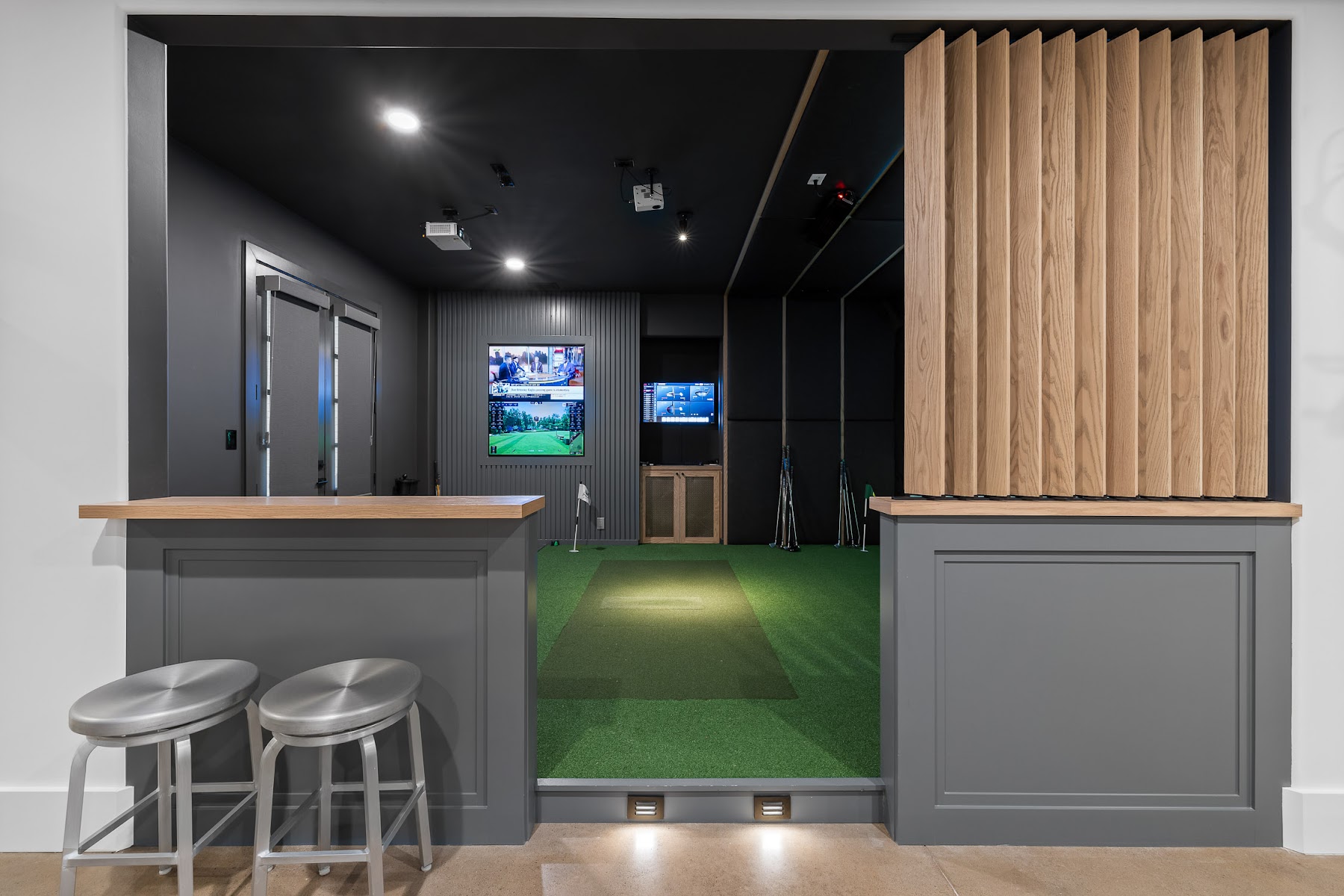
The Forge Club is one that we recently did in Holly Springs, Georgia. They have three bays and a merchandising area, and they’ve done really well, but that was right-sized to the facility that they were renting. They have a slot in a strip mall. It’s a great facility, and three bays is probably the right amount for them to support things like the rent and the cost in that area. But if your rent was really high, three bays aren’t going to help you cover it.
It’s a balancing act. You don’t want to overbuild for the demand you’re going to have. That’s where I like that flexible model where you start a little small and you see, hey, I’m packed. My four bays are busy at all hours of the day. Alright, let’s start adding on bays and see where demand starts to dwindle.
What should a commercial golf simulator lounge budget include?
Cliff Stevens: I hate to say everything, but it goes back to the planning. There’s the old adage of, if I have an hour to solve a problem, I’m going to spend fifty-five minutes planning and thinking and then five minutes actually solving the problem. I think too many people just say, oh, let’s start building. Give me a design, throw some simulators in there, and let me buy some stuff. I want to get going.
What you’re asking here is, what are all the elements I’m going to have to think about to make this business successful? What are my costs going to be? There’s the build costs. If I need to add on software to my business, what’s that going to cost me every month? The insurance, the food costs, the employee costs, payroll costs. It goes on and on.
Seeing people not think through all those things is terrifying, because you’re getting into a significant investment. Commercial leases are usually five-plus years of personal guarantees. If you haven’t thought through all these costs, then you’re setting yourself up for failure. We’d love to connect new potential clients with people that have been running these businesses for multiple years now so they can talk through some of the challenges, some of the things that maybe they didn’t think through.
That planning exercise is the most important part of all this, because you may get halfway through planning and say, you know what? In this market, this business isn’t viable, or I need to change my model entirely. I can’t have enough capacity at peak hours to support the business at $35 an hour. So maybe I have to be a membership-only business. Knowing all those costs helps you back into what you’re going to have to charge, how busy you’re going to have to be, your utilization rates, all that kind of stuff. Think about it early and be comprehensive. It’s super important.
Frequently Asked Questions
What is a good per-bay budget for a commercial golf simulator lounge?
Cliff Stevens says $50,000 per bay is a general starting point for a commercial lounge, and $50,000 to $100,000 per bay is a good range before adding extras. A five-bay facility is likely a minimum of $250,000.
What does a small two- or three-bay simulator business cost to build?
Without a restaurant or bar, a two- or three-bay commercial simulator business might cost $150,000 to $250,000 for a full build-out. Leasing, insurance and payroll come on top of that figure.
How many bays do most independent golf simulator lounges open with?
Most independently run lounges start with two to five bays. Stevens likes a flexible plan: start with two to four bays in a space that could hold more, then add bays as membership and demand grow.
How does rent affect the number of simulator bays?
Rent sets a minimum revenue the bays must support. Stevens notes that at $8,000 a month in rent, two bays probably won’t cover it unless rates are exorbitant, while three bays suited the Forge Club’s strip mall space in Holly Springs, Georgia.
What costs should a golf simulator lounge budget include besides construction?
Stevens lists recurring software costs, insurance, food costs, payroll and other employee costs. Commercial leases usually involve five-plus years of personal guarantees, so these costs should be modeled before signing.
Edited for length and clarity from a recorded conversation with Cliff Stevens.